Deionized Water Plant: Two-Bed and Mixed Bed DI
Water spots on polished steel come from the minerals dissolved in ordinary water, and the same minerals shorten the life of lead-acid batteries. A deionized water plant takes them out with ion exchange resin.
We size it after a free water test, to the volume and purity your work needs. Many are fitted after an RO plant, which removes the bulk of the salts first.
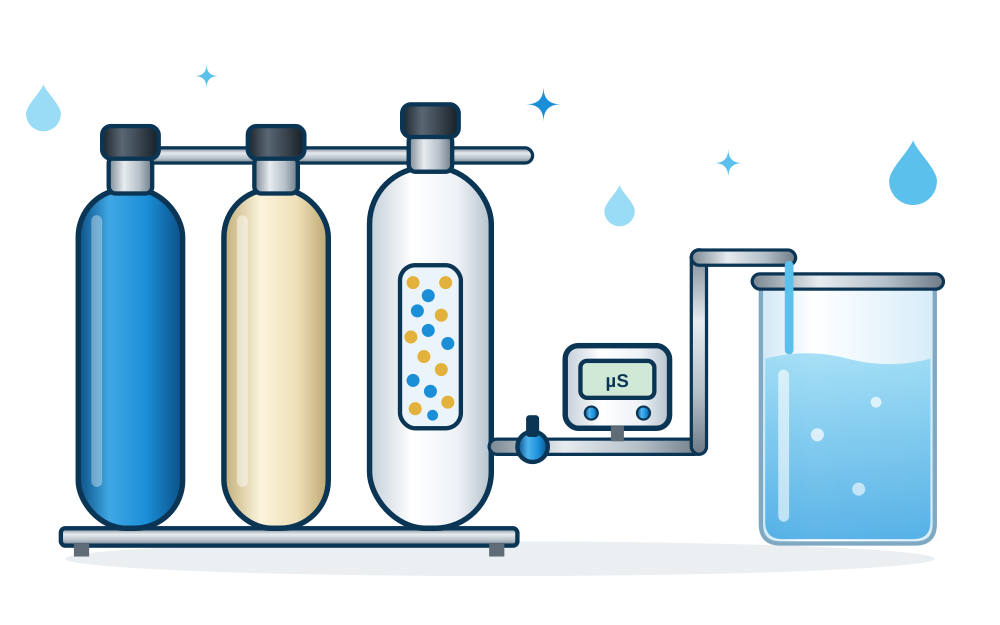
How deionisation works
Deionisation removes dissolved ions with ion exchange resin.
Cation resin swaps calcium, magnesium and sodium for hydrogen ions. Anion resin swaps chloride, sulphate and bicarbonate for hydroxide ions.
The hydrogen and hydroxide ions then combine into water. What comes out is demineralised water.
Two-bed unit or mixed bed deioniser
A two-bed unit has separate cation and anion vessels, one after the other.
A mixed bed deioniser holds both resins in one vessel and gives purer water. It is often used to polish water that has already been through a two-bed unit or an RO plant.
Why an RO plant usually comes first
Every bit of salt in the feed water uses up resin. Salty borewater straight into a deioniser means frequent regeneration.
Putting an RO plant before the deioniser removes most of the salts first, so the resin lasts much longer between regenerations. For factory-scale RO, see industrial RO plants.
Where DI water is used
- The final rinse after plating.
- Rinsing after passivation and polishing of surgical and dental instruments, a big part of Sialkot's industry, so polished steel dries without water spots.
- Topping up lead-acid batteries in UPS systems and workshops, which work hard through load shedding.
- Laboratories.
- Some boiler and cooling uses.
Regeneration and checking the output
Resin gets used up. It is then regenerated with acid for the cation resin and caustic soda for the anion resin, or exchanged for fresh resin. Both jobs need trained handling. We regenerate the resin for the plants we supply.
Output is checked with a conductivity meter on the outlet. A rising reading means the resin is exhausted.
Where an RO plant feeds the deioniser, its membranes and cartridges are looked after by our RO plant service.
What DI water is not
DI water is not drinking water. It has no minerals, and deionisation does not remove bacteria.
If you need drinking water, an RO plant with UV is the system to look at.
How a deionized water plant is priced
We build each plant to the customer's requirement, from a small unit for a laboratory or a battery workshop to a plant for a plating or finishing line.
There is no standard price for this. We quote per project after a water test and a look at how much water you need each day and how pure it has to be.
Start with a free water test.
Frequently Asked Questions
What is the difference between DI water and RO water?
An RO plant pushes water through a membrane and removes most of the dissolved salts. A deioniser uses ion exchange resin to take out the dissolved ions that are left.
Many plants run RO first and a deioniser after it to polish the water.
Can I use DI water instead of distilled water in batteries?
For topping up lead-acid batteries, both do the same job: water with the dissolved salts taken out. Follow the battery maker's instructions on what to use.
How often does the resin need regenerating?
It depends on your feed water and how much water you use. We size the plant after a water test, so we can tell you then. We regenerate the resin for the plants we supply.
Is DI water safe to drink?
It is not drinking water. It has no minerals, and deionisation does not remove bacteria. For drinking water, an RO plant with UV is the right system.
What does the conductivity meter on the outlet tell me?
It shows how much dissolved matter is left in the water coming out. When the reading starts to rise, the resin is exhausted and needs regenerating or replacing.
Ask about a DI plant
Tell us what the water is for and roughly how much you need each day.
We start with a free water test and quote after it.
General water test free, by TCS from any city. Site visits are free inside Sialkot district. In other cities, the visit charge depends on distance, so ask us first.