Commercial and industrial RO side by side
| Feature | Commercial RO plant | Industrial RO plant |
|---|---|---|
| Typical capacity | About 100 to 2,000 LPH | 3,000 LPH and above |
| Running hours | A working day, with rest and flushing | Long shifts, often around the clock |
| Membranes | Mostly 4 inch elements | 8 inch elements in larger arrays |
| Pre-treatment | Sand, carbon, cartridges, antiscalant | Larger multimedia, softener or iron removal as needed, antiscalant |
| Controls | Manual or basic automatic, low pressure cut-off | Automatic panel, flushing, conductivity and pressure monitoring |
| Membrane cleaning | Occasional, often off-site | Clean-in-place (CIP) built in |
| Target | Drinking water within national limits | A process, rinse or boiler feed specification |
| Market price | PKR 115,000 to 475,000 for small plants, PKR 960,000 to 1,250,000 at 2,000 LPH | Starts from about PKR 1,200,000, quoted per project |
Prices are October 2026 market ranges. Capacity is the line people look at first, but it is the least useful one. A 2,500 LPH plant for a housing society's drinking water is still a commercial plant at heart. A 1,000 LPH plant feeding a plating line around the clock needs industrial design.
What the water is for decides the class
Drinking water has a clear target: Pakistan's national limits, or 500 mg/L TDS for bottled water. Most commercial plants hit that comfortably.
Industrial water is judged against the machine or process that uses it. A rinse line after polishing or passivation needs water that dries without spots. A steam boiler needs low hardness and, at higher pressures, low conductivity. Some laboratory and electronics work needs conductivity that RO alone cannot reach, so a deionized water plant is added after the RO.
When a commercial plant is enough
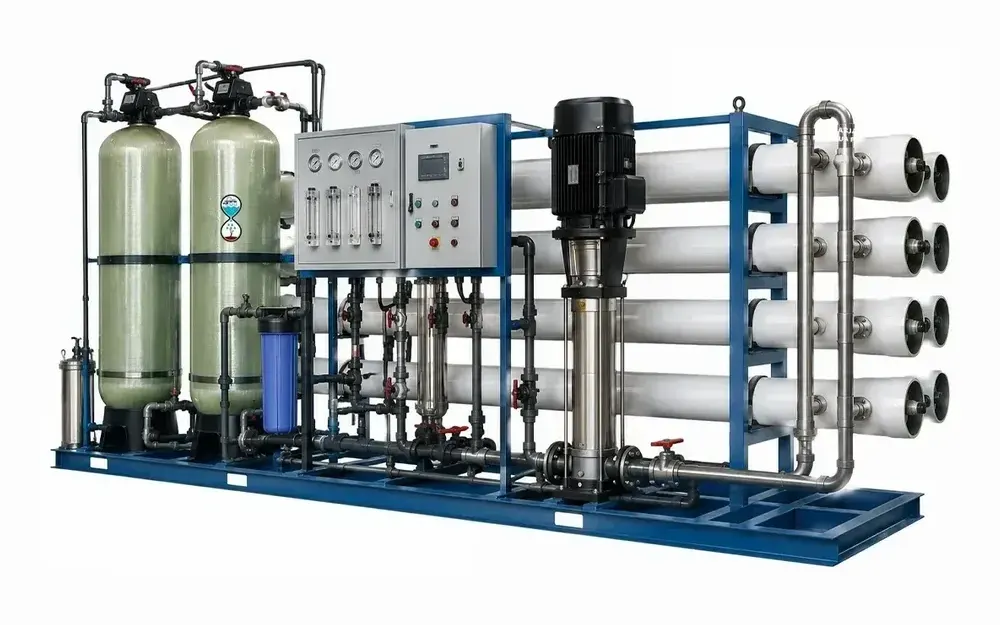
A commercial RO plant is the right class when:
- The water is for drinking and cooking: schools, hospitals, offices, restaurants, mosques, housing societies and water shops.
- The plant can run for a working day and fill a storage tank for the peak.
- The feed water is ordinary boring or line water with moderate hardness.
- Ice factories and poultry farms, which need clean, low TDS water but not a tight process specification.
Sizing a commercial plant is mostly arithmetic. Our guide on how to choose an RO plant walks through it.
When you need an industrial plant
Sialkot's industry gives the clearest examples. Surgical instrument units rinse parts after polishing. Sports goods and leather factories run steam boilers. Both use water for hours on end, often from hard borewater, and both are hurt more by a stopped plant than by its price.
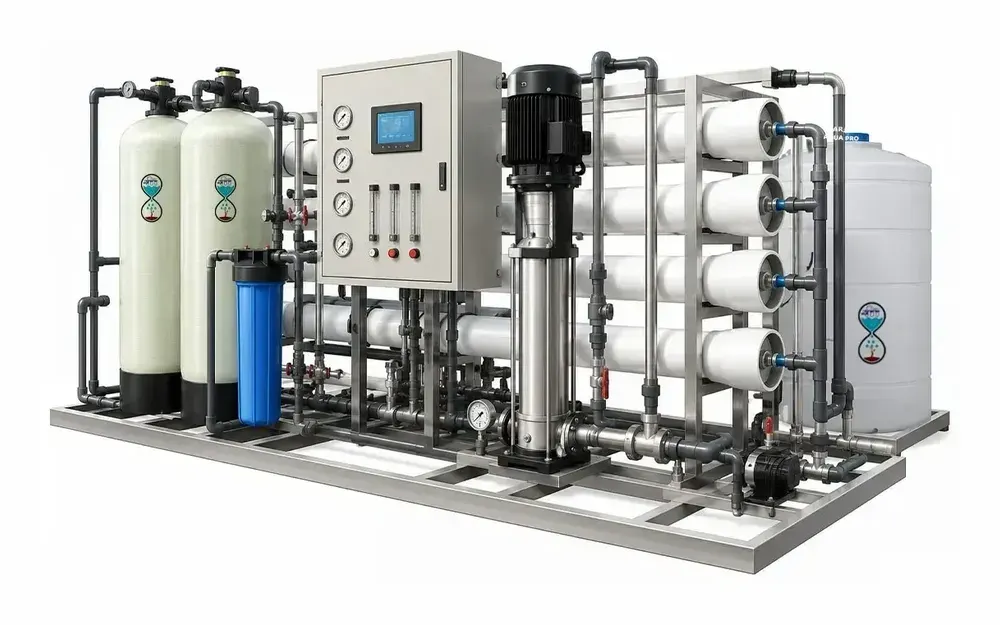
You need industrial design when one or more of these is true:
- The plant has to run through long shifts, or around the clock.
- The feed water is very hard, carries iron or changes with the season.
- There is a written specification for conductivity, hardness or silica.
- Downtime costs production, so alarms, automatic flushing and spare capacity matter.
- The water feeds a boiler, where scale means more fuel for the same steam.
Boiler feed water is a decision of its own. A softener removes hardness, the main cause of scale. An RO also lowers TDS, which cuts blowdown. Which one you need depends on the boiler's pressure and the maker's specification. Our comparison of a water softener vs RO plant covers the trade-offs.
Buying cost and running cost
Industrial plants cost more to buy because of the larger membrane array, the pre-treatment and the automation. They also cost more to run: electricity for the high pressure pump through long shifts, antiscalant, cartridge changes, cleaning chemicals and regular membrane cleaning.
The cheaper plant is not always the cheaper choice. A commercial plant pushed to industrial hours wears out its pump and membranes early, and its owner pays for them twice. A maintenance contract is part of the running cost to plan for. See RO plant maintenance.
What to settle before asking for a quote
- A full laboratory report of the raw water.
- Daily volume, and the peak flow during production hours.
- Running hours, and how load shedding is covered: generator, solar or none.
- The boiler or process specification, if there is one.
- Space for the plant, a drain for reject and backwash water, and the power supply available.
With those five, a quote can be compared line by line. A site visit is free anywhere inside Sialkot district, including Daska and Sambrial. Outside the district, the visit charge depends on distance. See our industrial RO plants page for what we build for factories.
Sources
- Pakistan EPA, National Standards for Drinking Water Quality (Ministry of Climate Change copy)
- World Health Organization, Guidelines for drinking-water quality
Prices are market ranges, not quotes, and are rechecked every three months. Standards are quoted as published. For a decision about your own water, go by a test of that water.