Step 1: work out how much water you need
Start with litres per day on your busiest day, not your average day. A few ways to count it:
- People. WHO's guidelines assume an adult drinks about 2 litres a day. Plan on more in a Punjab summer, and more again if cooking water comes from the plant.
- Bottles. For a water shop, count the 19 litre bottles you expect to fill on the busiest day and multiply by 19.
- Process. For a factory, ask the machine or boiler supplier for the hourly water use and the hours the line runs.
Write down the peak hours too. A school uses most of its water between morning assembly and the last period. A water shop does most of its trade in the evening.
Step 2: turn that into litres per hour
Divide the daily litres by the hours the plant can actually run. A school that needs 3,000 litres between 8 am and 2 pm has six hours, so it needs a plant near 500 LPH. Size it on a 24 hour day and the tank runs dry before lunch.
If your area has load shedding and the plant has no generator or solar backup, count only the hours with electricity. Then size the storage tank to carry you through the peak. Storage is cheaper than plant capacity, and it is what keeps a water shop serving during the evening rush.
| Plant rating | Litres in 24 hours | About US gallons per day |
|---|---|---|
| 250 LPH | 6,000 | 1,585 GPD |
| 500 LPH | 12,000 | 3,170 GPD |
| 1,000 LPH | 24,000 | 6,340 GPD |
| 2,000 LPH | 48,000 | 12,680 GPD |
Remember the reject water. An RO plant sends part of its feed to the drain carrying the removed salts. The feed pump and the borewater supply have to deliver the product water plus the reject, so a 500 LPH plant may need well over 700 litres an hour going in. The share depends on the feed TDS and the design.
Step 3: let the water report set the pre-treatment
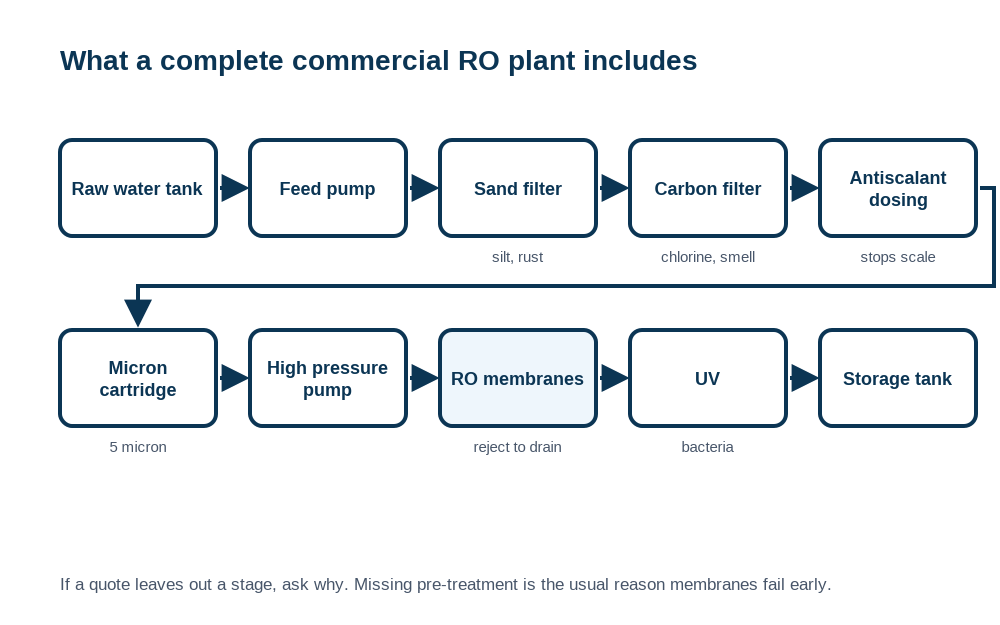
Membranes are the expensive part of an RO plant, and pre-treatment is what protects them. A full laboratory report of the raw water tells the designer what each stage has to deal with.
| In the water report | Pre-treatment it calls for |
|---|---|
| Silt, high turbidity | Multimedia sand filter, then micron cartridges |
| Chlorine (treated line water) | Activated carbon filter, because chlorine damages membranes |
| Moderate hardness | Antiscalant dosing before the membranes |
| Very high hardness | Water softener ahead of the RO |
| Iron or manganese | Iron removal filter before the sand filter |
| Bacteria | UV after the membranes, and a clean storage tank |
| Arsenic | RO reduces it. Confirm with a lab test of the treated water. |
Our free general test gives you TDS and pH in a few minutes, which is enough for a first estimate. For a plant serving a school, hospital or bottling line, the full lab report is worth its fee. See how to test water quality.
Step 4: check what is inside the plant
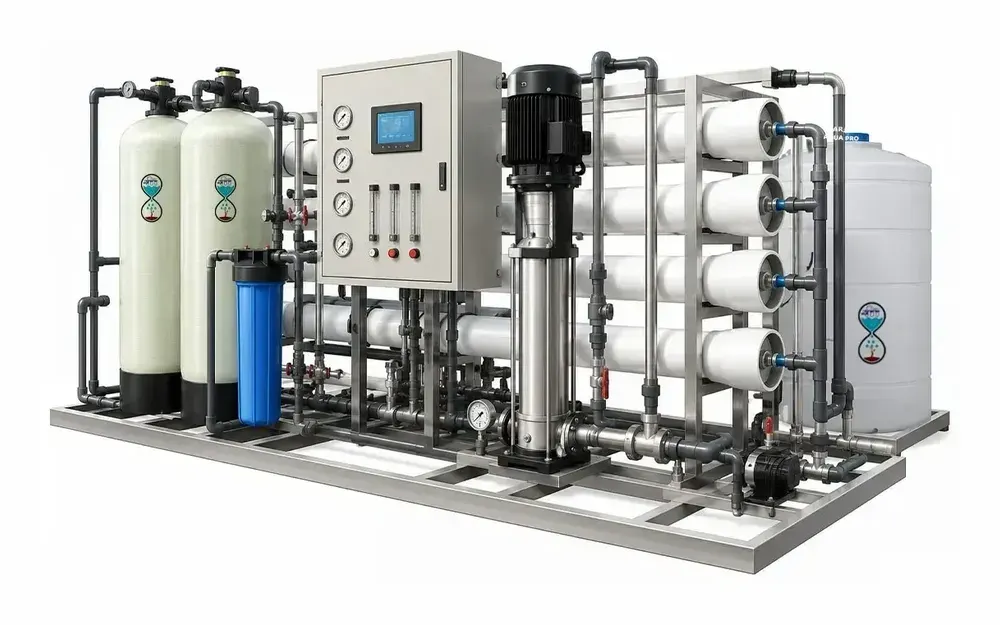
Commercial plants use membrane elements 4 inches or 8 inches across and 40 inches long. A common 4 inch brackish water element is rated at roughly 2,000 to 2,400 GPD under the maker's test conditions, which is about 315 to 380 LPH. An 8 inch element is rated at roughly 9,000 to 11,000 GPD. Real plants are designed to produce less than the rating, because borewater is warmer, saltier or harder than the test water.
So a bigger plant uses more elements, not a bigger membrane. If a quote claims 1,000 LPH from a single 4 inch membrane, the numbers do not add up.
Step 5: read the quote line by line
A proper quote lists each of these. If one is missing, ask.
| Item | What to look for |
|---|---|
| Capacity | In litres per hour, at a stated feed TDS |
| Membranes | Size (4 or 8 inch), number of elements, make |
| Pressure vessels | Material and number |
| High pressure pump | Make and motor power |
| Pre-treatment | Each filter vessel, with media and size |
| Dosing | Antiscalant pump and tank |
| Post-treatment | UV, and mineral dosing if needed |
| Instruments | Pressure gauges, flow meters, TDS or conductivity meter, low pressure cut-off |
| Storage | Tank size and material, food grade for drinking water |
| Installation | Piping, electrical panel, commissioning and an output test |
| After-sales | Warranty terms and who services the plant |
Red flags in an RO plant quote
- Capacity given as "1,000 litres" with no "per hour". That may be a tank size.
- No sand or carbon filter on borewater or chlorinated line water.
- No antiscalant on hard water.
- Membrane count missing, or too few elements for the claimed LPH.
- No mention of where the reject water goes.
- A price far below everyone else's with no stage list attached.
RO plant prices by capacity
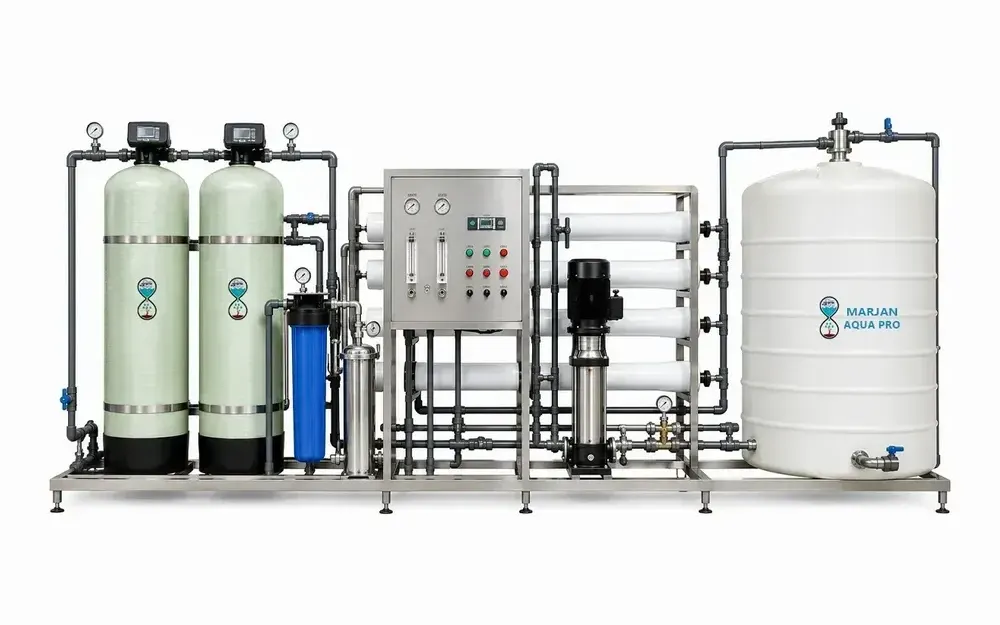
At October 2026 market prices, a light commercial plant of about 100 to 250 LPH costs about PKR 115,000 to 475,000. A 500 LPH plant costs about PKR 490,000 to 650,000, 1,000 LPH about PKR 550,000 to 900,000 and 2,000 LPH about PKR 960,000 to 1,250,000. Industrial plants of 3,000 LPH and above start from about PKR 1,200,000. The spread inside each range is mostly pre-treatment, membrane make and the steel or FRP used.
The full table is on the price list. For sizes, uses and our installation work, see RO plants. If the plant is for a factory process or a boiler, read commercial vs industrial RO first.
Sources
- World Health Organization, Guidelines for drinking-water quality (uses 2 litres a day of drinking water per adult)
- Pakistan EPA, National Standards for Drinking Water Quality (Ministry of Climate Change copy)
Prices are market ranges, not quotes, and are rechecked every three months. Standards are quoted as published. For a decision about your own water, go by a test of that water.