Water shop or bottling plant?
Most new businesses start with a water shop that refills 19 litre bottles over the counter. A bottling plant fills and seals bottles for shops, offices and distributors, and needs more machinery, more space and more paperwork.
| Feature | Water shop | Bottling plant |
|---|---|---|
| Sells | 19 litre refills at the counter, local delivery | Sealed 19 litre, 6 litre, 1.5 litre and 500 ml bottles |
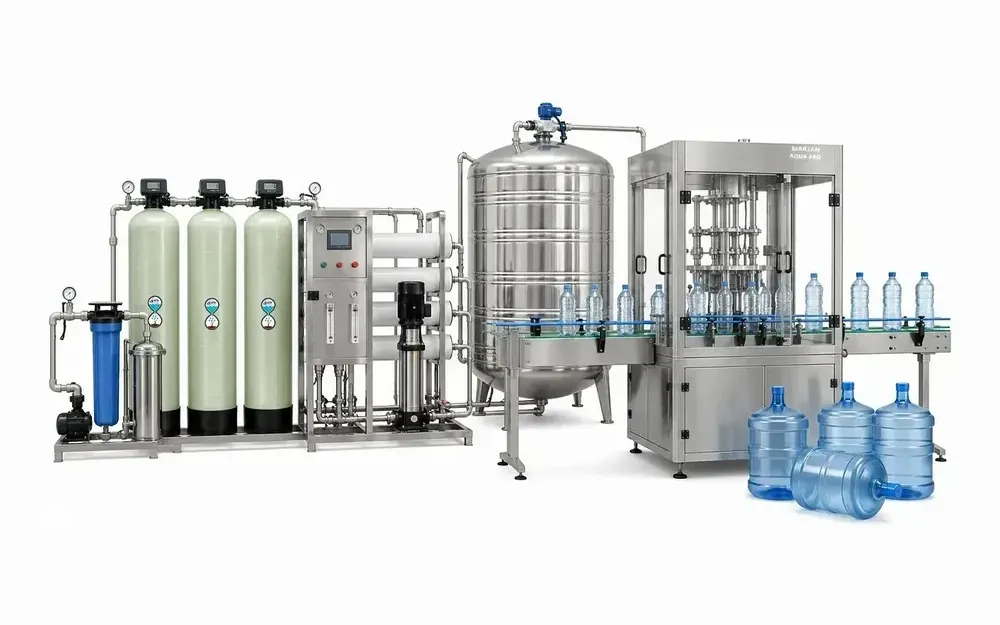
| Equipment | RO plant, filling counter, storage tank | RO, mineral dosing, ozone, washing, filling and capping line |
| Space | Roughly 250 square feet for a small plant | More, with separate bottle storage |
| Licence | Check PSQCA and your provincial food authority | PSQCA certification for bottled drinking water |
| Market price | PKR 290,000 to 800,000 | Starts from about PKR 1,200,000 |
Prices are October 2026 market ranges for the treatment and filling equipment only.
What decides the setup cost
- The raw water. High TDS, hardness or iron need more pre-treatment and wear membranes faster.
- Capacity. Size the RO for your busiest day and the hours you have power. See how to choose an RO plant.
- Storage. A water shop lives or dies on the evening rush, and storage carries it, not plant size.
- Materials. Food grade stainless steel tanks and fittings cost more than plastic and FRP, and last longer.
- Automation. Manual filling is cheap. Automatic washing, filling and capping lines cost much more and need three phase power.
- Disinfection. Ozone or UV before filling, with the ozone dose set to your water.
Licences and standards
Bottled drinking water is on PSQCA's list of items that need compulsory certification. Pakistan's standards treat it, PS:4639, as a separate product from natural mineral water, which comes from an underground source and is bottled close to it. Most plants called mineral water plants in Pakistan make bottled drinking water, and the finished water has to stay at or below 500 mg/L TDS.
Food businesses are also regulated by the provincial food authority. In Punjab, that is the Punjab Food Authority. Check its registration and inspection requirements before you open, and keep regular lab reports of your finished water on file. Rules change, so treat this as a checklist of who to ask, not as legal advice.
Running costs and your cost per bottle
A plant that is cheap to buy but expensive to run per bottle is a poor deal. Work out your cost per bottle before you set a selling price. Add up a month of these, then divide by the bottles you expect to fill that month:
| Cost | How to estimate it |
|---|---|
| Electricity | Pump and ozone power, multiplied by running hours |
| Cartridges and membranes | Replacement cost divided by their life in months |
| Antiscalant and mineral dosing chemicals | Monthly use at your water's dose |
| Bottles and caps | Bottles lost or damaged each month, plus new caps and seals |
| Lab tests | Finished water tests at the frequency your licence requires |
| Servicing | Maintenance contract or call-out costs |
| Rent, staff and delivery | Your fixed monthly costs |
As a market guide, yearly upkeep of a filtration plant runs about PKR 10,000 to 50,000 a year (October 2026), depending on size and water. Your real figure comes from your raw water and your volume.
Keeping the water right every day
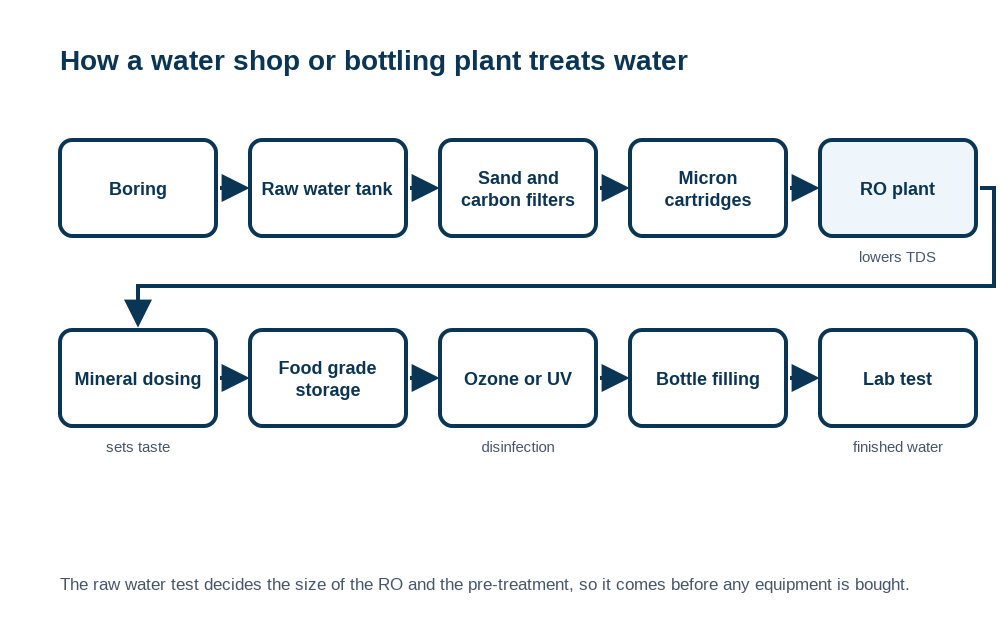
Customers judge a water shop by taste and by the TDS meter on the counter. Mineral dosing sets the taste, so the final TDS is a decision rather than an accident. Water straight off the membrane tastes flat. Our guide to safe TDS levels explains the numbers.
Regulators do check. In PCRWR's April to June 2026 round, 230 bottled water samples from 20 cities were tested against PSQCA standards, and 29 brands failed. 22 had bacteria, 9 had sodium above the 50 ppm limit and 4 had TDS above 500 ppm. Bacteria, the most common failure, usually gets in after the RO: through a dirty storage tank, badly washed bottles or an open filling area.
The daily routine matters as much as the plant: wash and inspect returned bottles, check output TDS morning and evening, change cartridges on schedule, clean the storage tank, and keep the filling area separate from bottle storage. A single batch of contaminated bottles can cost a shop its customers.
Mistakes that sink new water businesses
- Buying equipment before testing the raw water.
- Sizing the plant for an average day and running dry every evening.
- Opening without checking the licence and food authority requirements.
- Choosing the cheapest membranes and skipping pre-treatment, then replacing membranes within months.
- No plan for reject water, which can be a large share of what the boring pumps.
- Opening next to three established shops with nothing different to offer.
Steps to start, in order
- Get a full laboratory test of the raw water. See how to test water quality.
- Decide between a water shop and a bottling plant, and estimate daily volume.
- Check PSQCA and provincial food authority requirements for that model.
- Confirm the room: covered, about 250 square feet for a small plant, the right power supply, and a drain for reject and backwash water.
- Get quotes that list every stage, the LPH and the storage, and compare them line by line.
- Install, commission and send the finished water for a lab test before the launch.
Our mineral water plant page covers what we install for water shops and bottling businesses, and the price list has every market range.
Sources
- PSQCA, list of compulsory items to meet Pakistan Standards
- PCRWR, Quarterly report on bottled water quality, April to June 2026
- The Nation, 29 bottled water brands found unsafe for consumption (August 2026)
- Pakistan EPA, National Standards for Drinking Water Quality (Ministry of Climate Change copy)
- World Health Organization, Guidelines for drinking-water quality
Prices are market ranges, not quotes, and are rechecked every three months. Standards are quoted as published. For a decision about your own water, go by a test of that water.