What you can test at home, and what needs a lab
Home tests are good at the things that affect taste, scale and the choice of filter. Laboratory tests are for the things that affect health. The table shows where each one sits.
| What you are checking | Home test | Needs a lab? |
|---|---|---|
| Colour, cloudiness, smell | A clear glass and your nose | Only if something looks wrong |
| TDS (dissolved salts) | Pen type TDS meter | No |
| pH | Test strips, drop kit or pH pen | No, unless the reading is far outside 6.5 to 8.5 |
| Hardness | Hardness strips or a drop kit | For an exact figure, yes |
| Bacteria (coliforms, E. coli) | Home kits give yes or no only | Yes |
| Arsenic | Field kits give a rough range | Yes, before buying a filter |
| Nitrate, fluoride, lead, iron | Strips give a rough idea | Yes |
Step 1: look and smell
Fill a clear glass and hold it against a white wall in daylight. It sounds basic, but it catches a surprising number of problems.
- Cloudy or sandy. Silt from the boring, or sediment stirred up in a roof tank. A sediment filter or a UF plant deals with it.
- Yellow or brown. Usually iron or rust from old galvanised pipes. Iron also leaves orange stains in sinks and buckets.
- Rotten egg smell. Hydrogen sulphide, common in some deep borings. Carbon and aeration help, and it is worth a lab test.
- Strong chlorine smell. Line water that has been chlorinated. A carbon filter removes it, and it must be removed before any RO membrane.
- Earthy or musty taste. Often a tank that needs cleaning rather than a problem at the source.
Do not taste water that looks or smells wrong. Clear, odourless water can still carry germs, so a clean glass is the start of testing, not the end of it.
Step 2: test TDS
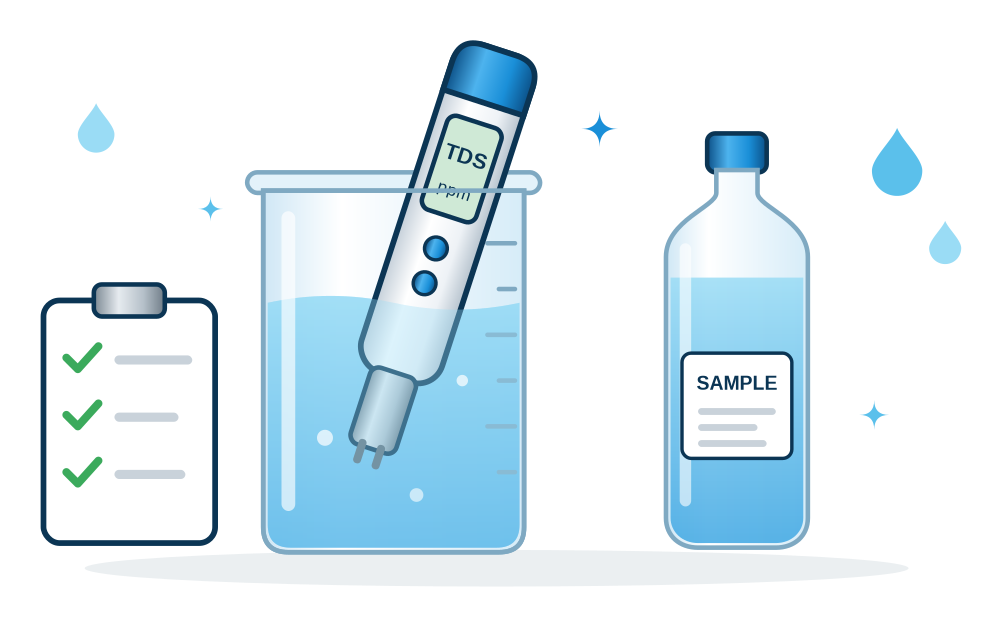
A pen type TDS meter costs about PKR 800 to 1,650 (October 2026). Dip it to the marked line, wait for the number to settle and note it down. Below 500 mg/L is within the bottled water standard. Above 1,000 mg/L is over the national drinking water limit and usually needs RO.
Our guide to safe TDS levels in drinking water has the full chart and explains what a reading cannot tell you.
Step 3: check pH and hardness
pH strips are cheap and accurate enough to tell you whether you are inside the national range of 6.5 to 8.5. A pH pen is more precise but needs calibrating with buffer solution. RO water often reads slightly below 7, which is normal and explained in our pH of water guide.
Hardness strips change colour with the calcium and magnesium in the water. If they show hard or very hard water and your geyser and taps are scaling, read signs of hard water and what fixes it before buying anything.
When to get a laboratory test
A lab test costs money, so it makes sense to know when it is worth it. These are the cases where we always recommend one:
- A new boring, before anyone drinks from it.
- Any boring used for drinking, at least once a year.
- After flooding, after sewer or drain work nearby, or when several people in the house have stomach upsets.
- Before buying an RO plant for a water shop, bottling plant, school or hospital. The plant is designed from the report.
- Where arsenic has been found nearby, which covers large parts of Punjab. See arsenic in Punjab groundwater.
- Where babies are fed formula made with the water. WHO's nitrate limit exists mainly to protect bottle-fed infants.
- After installing an arsenic filter or a new plant, to confirm it works.
How to take a sample that gives a true result
A bad sample gives a bad result, and a bacteria test is the easiest one to spoil.
- Use a clean plastic bottle for chemical tests. An emptied new mineral water bottle works.
- Run the tap for a minute, then rinse the bottle three times with that water.
- Fill to the top and close the cap tightly.
- Write the source (boring, line or tank), your area and the date on the bottle.
- For bacteria, use only the sterile bottle the laboratory gives you. Do not rinse it, do not touch the inside of the cap, keep it cool and ask the lab how quickly it must arrive. It is usually within a day.
Reading a lab report against Pakistan's limits
Lab reports list each parameter beside a limit. These are the values in Pakistan's National Standards for Drinking Water Quality for the tests most people ask about.
| Parameter | National limit | If it is over the limit |
|---|---|---|
| TDS | below 1,000 mg/L | RO plant or home RO |
| pH | 6.5 to 8.5 | Depends on the cause, ask us with the report |
| Total hardness (as CaCO3) | below 500 mg/L | Softener, or RO for drinking water |
| Arsenic | 0.05 mg/L (50 µg/L) or less | Arsenic removal plant or RO, then retest |
| Nitrate | 50 mg/L or less | RO, and find the source (septic tanks, fertiliser) |
| Fluoride | 1.5 mg/L or less | RO |
| Total coliforms and E. coli | None in 100 mL | Find the leak, disinfect, then UV |
WHO's arsenic guideline is stricter than Pakistan's, at 10 µg/L. If your report shows anything between 10 and 50, it passes the national standard but we would still treat drinking water.
Where to get water tested in Pakistan
PCRWR, the Pakistan Council of Research in Water Resources, runs water quality laboratories in several cities and tests samples from the public for a fee. Private laboratories accredited by the Pakistan National Accreditation Council are the other option. Ask either for a price per parameter and how they want the sample delivered.
For TDS and pH, you do not need a lab. Our free water test covers both plus an electrolyser check, at our shop in Bajwa Market, Wazirabad Road, Ugoki, or by TCS from anywhere in Pakistan. If the readings or your area point to a lab test, we say so and tell you the fee before anything is sent.
Sources
- Pakistan EPA, National Standards for Drinking Water Quality (Ministry of Climate Change copy)
- World Health Organization, Guidelines for drinking-water quality
- Pakistan Council of Research in Water Resources (PCRWR), water quality assessment
Prices are market ranges, not quotes, and are rechecked every three months. Standards are quoted as published. For a decision about your own water, go by a test of that water.