What the research found in Punjab
In 2017, researchers from Eawag, the Swiss water research institute, working with Pakistani scientists, published the first countrywide arsenic hazard map for Pakistan in Science Advances. They tested groundwater from nearly 1,200 sites, mostly hand pumps and motor pumps, and used the results to model risk across the country.
Their estimate was that 50 to 60 million people use groundwater in the area at risk, much of it along the Indus and its tributaries in Punjab and Sindh, with hot spots around Lahore. Some Pakistani experts questioned whether that number of samples could support a national estimate. The lead author's own advice was the useful part: arsenic varies widely over short distances, so individual borings need testing.
For a household in Sialkot, Gujranwala or Lahore, that means two things. Arsenic is a real possibility in Punjab groundwater. And nothing about your area tells you whether your own boring has it.
How much arsenic is too much?
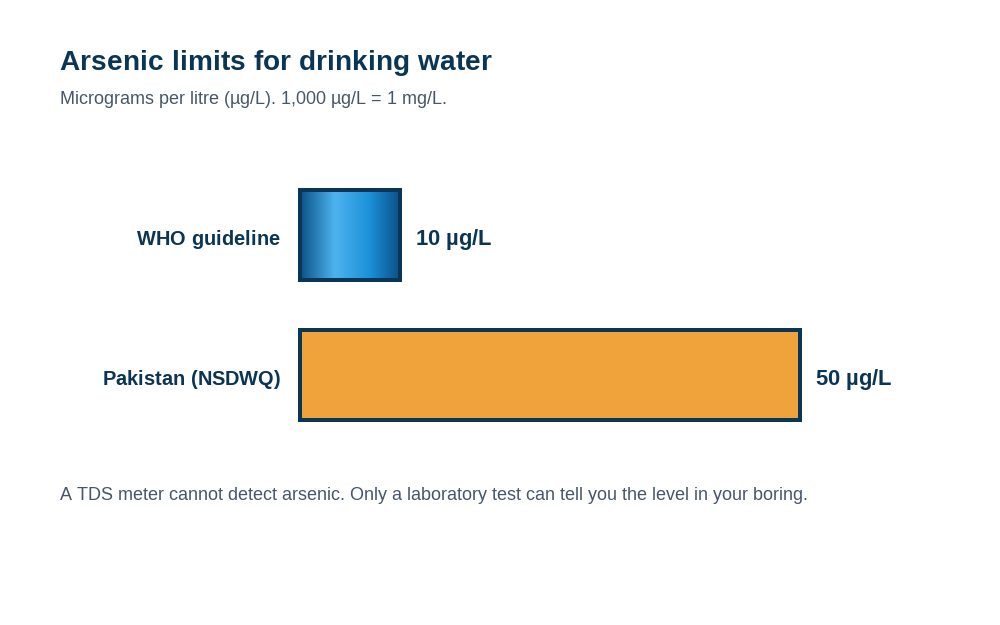
Arsenic is measured in micrograms per litre (µg/L), which is a thousandth of a milligram. Pakistan's National Standards for Drinking Water Quality allow up to 50 µg/L. WHO's guideline is five times stricter, at 10 µg/L.
| Lab result | Against the limits | What we would do |
|---|---|---|
| Below 10 µg/L | Within WHO and Pakistan limits | No arsenic treatment needed. Retest yearly. |
| 10 to 50 µg/L | Passes Pakistan's limit, fails WHO's | Treat drinking and cooking water |
| Above 50 µg/L | Fails both | Treat before drinking, then retest |
Why arsenic is taken seriously
The concern is long-term drinking, not a single glass. WHO links years of exposure to arsenic in drinking water with skin lesions, heart disease and some cancers. Effects can take years to appear, which is exactly why a boring that has been used for a decade without trouble still deserves a test.
We install treatment equipment. We are not doctors, and nothing here is medical advice. If you are worried about your family's health, take the lab report to a doctor.
How to find out about your own boring
- Ask a laboratory for an arsenic test. PCRWR and accredited private laboratories do this for a fee. Ask the price first.
- Take the sample from the tap closest to the boring, before any filter, after running it for a minute.
- Use the bottle the lab gives you, or a clean new plastic bottle if they allow it, and label it with the source and date.
- If you already have a filter, test both the raw water and the filtered water. That tells you whether the filter is working.
Field test kits exist and are used in surveys, but they give a rough range, not a figure to design a plant on. Our free general test covers TDS and pH only, so it cannot detect arsenic. We can arrange the lab test and tell you the fee before the sample goes. See how our water testing works, or the wider guide on how to test water quality.
What removes arsenic, and what does not
Arsenic in groundwater comes in two chemical forms. One is much easier to filter than the other. According to the 2017 study's lead author, the form common across much of the Indus plain is the easier one, but some water still needs an oxidation step first to convert the rest. A lab report and the right design matter more than the brand of filter.
| Method | Removes arsenic? | Best for |
|---|---|---|
| Adsorption media plant | Yes, until the media is used up | Whole house, community and larger flows |
| RO plant or home RO | Reduces it substantially | Drinking and cooking water |
| Oxidation before filtration | Helps the other methods work | Water where the harder form is present |
| Sediment, carbon or UV filter | No | Dirt, taste and germs only |
| Water softener | No | Scale only |
| Boiling | No, it concentrates arsenic | Killing germs only |
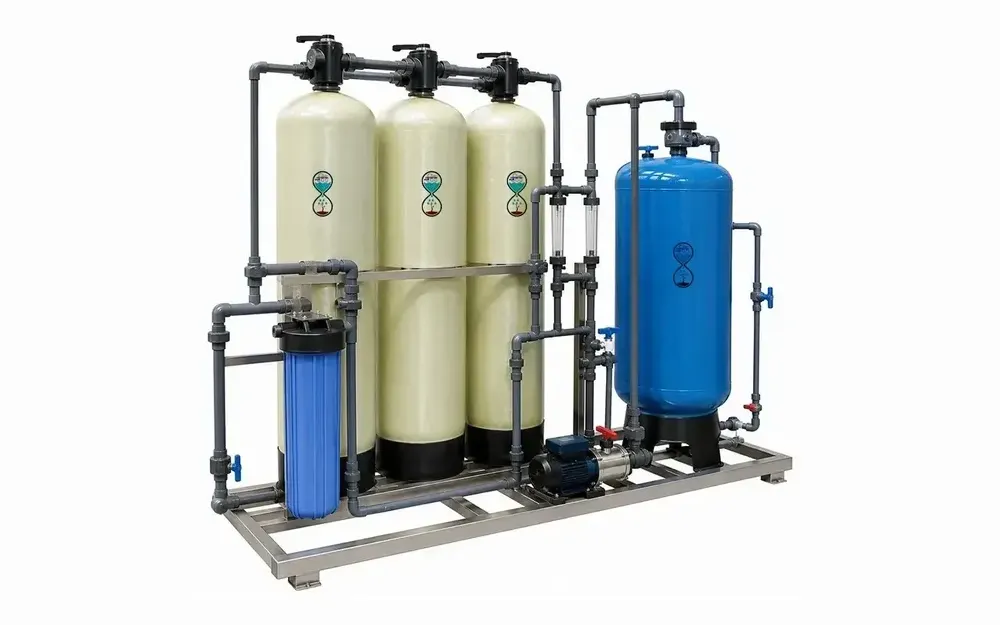
For a family, the usual answer is a home RO on the kitchen tap for drinking and cooking. For a mosque, school, housing society or a whole house, a media plant sized for the daily flow makes more sense. Our arsenic removal filters page explains both options.
After the filter is installed
An arsenic filter does not tell you when it stops working. Adsorption media fills up gradually, and once it is used up arsenic passes straight through while the water looks exactly the same.
That is why we recommend a lab test of the treated water after installation, whenever the media or membrane is changed, and at least once a year. It is the only real proof the filter is doing its job.
Sources
- Podgorski et al., Extensive arsenic contamination in high-pH unconfined aquifers in the Indus Valley, Science Advances (2017)
- World Health Organization, Arsenic fact sheet
- Pakistan EPA, National Standards for Drinking Water Quality (Ministry of Climate Change copy)
- AAAS, Toxic levels of arsenic widespread in Pakistan's groundwater (2017)
Prices are market ranges, not quotes, and are rechecked every three months. Standards are quoted as published. For a decision about your own water, go by a test of that water.