Start with where your water comes from
The source tells you what to test for before you spend anything. These are the usual patterns.
| Water source | Usual problems | Where to start |
|---|---|---|
| Boring (own motor pump) | TDS and hardness vary widely. Arsenic in parts of Punjab. | Test TDS. Home RO if it is high. Lab test for arsenic. |
| Municipal line water (WASA, TMA) | Chlorine taste, germs from leaking pipes, sediment | 3 stage UV filter if TDS is fine |
| Tanker water | Changes from one load to the next | Home RO with UV, and keep the tank clean |
| Roof or underground tank | Sediment and germs grow in a dirty tank | Clean the tank, then sediment and UV filtration |
Every one of these can also carry germs if the tank is dirty or a pipe leaks. Clean storage matters as much as the filter.
Let the TDS reading decide
The single most useful number is your TDS. It decides whether you need RO, which is the biggest cost difference between filters.
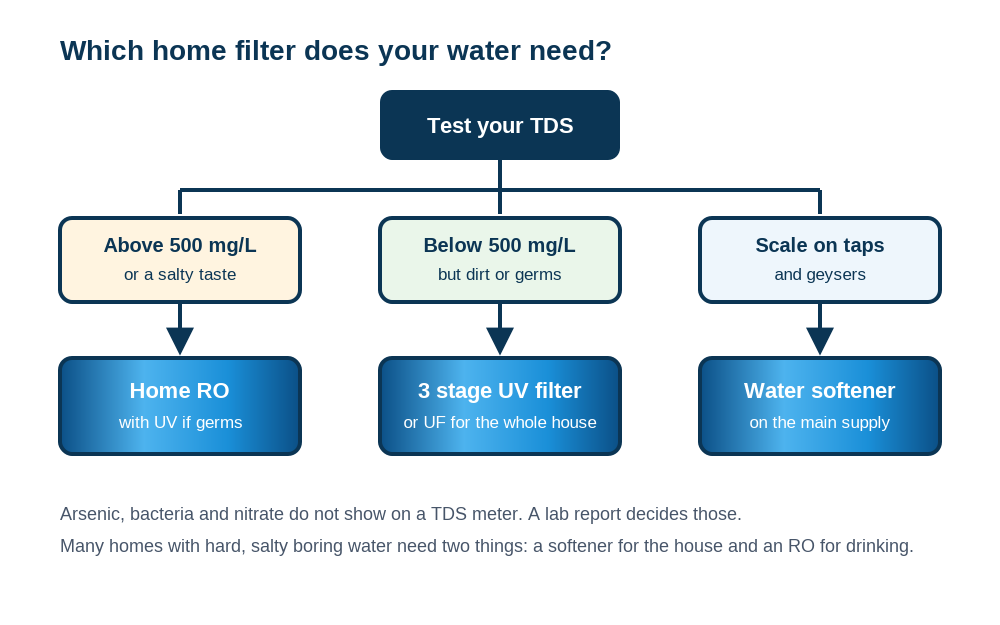
Below about 500 mg/L, the water is within the bottled water standard. An RO would mostly be removing minerals you do not need to remove, and sending water down the drain to do it. Above about 500 mg/L, the water usually tastes heavy, and above 1,000 mg/L it is over the national limit. That is where RO earns its cost. Our TDS guide has the full chart.
Which filter do I need?
Three quick questions. Your answers stay on your phone until you choose to send them.
Home water filters compared
Market prices are for October 2026. Your exact price depends on the stages, membrane and pump.
| Filter | Removes | Does not remove | Market price |
|---|---|---|---|
| 3 stage filter, non-electric | Sediment, chlorine, taste and smell | Germs, salts, arsenic | PKR 8,500 to 13,000 |
| 3 to 5 stage UV filter | Sediment, chlorine, and kills bacteria | Salts (TDS), hardness, arsenic | PKR 14,500 to 18,500 |
| Home RO, 5 to 7 stages | Most salts, hardness, much of the arsenic and heavy metals | Not a guarantee against germs without UV | PKR 28,500 to 40,000 |
| Home RO with UV, 8 to 9 stages | Salts, hardness, and kills bacteria | Nothing major, if serviced on time | PKR 38,000 to 46,000 |
| UF plant (whole house) | Silt, rust, bacteria for every tap | Salts (TDS), hardness | PKR 485,000 to 550,000 |
| Water softener | Hardness, so no scale | Germs, salts, arsenic | PKR 75,000 to 95,000 |
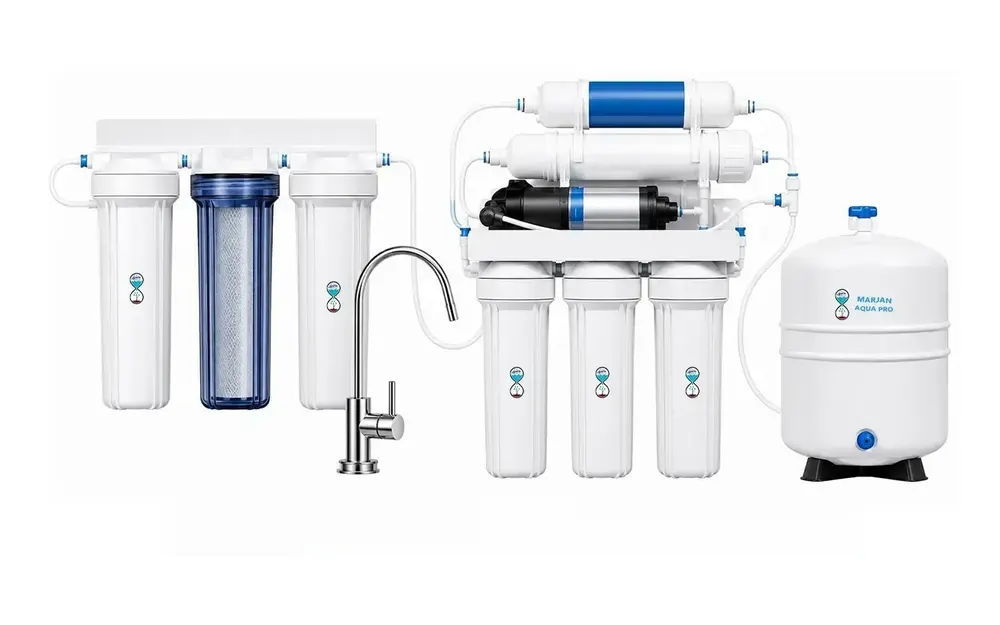
Two trade-offs are worth knowing. A home RO sends part of the water to the drain with the removed salts, and on many units the drain water is more than the filtered water. Many families collect it for mopping. A UV filter wastes nothing, but the lamp needs power, so it stops during load shedding unless it is on a UPS point.
What each filter costs to run
The purchase price is only part of it. Cartridges, membranes and UV lamps are used up, and a filter running on spent cartridges can be worse than no filter.
| Part | Typical life | Shortened by |
|---|---|---|
| Sediment cartridge | 3 to 6 months | Sandy or muddy water |
| Carbon cartridge | 6 to 12 months | Heavily chlorinated line water |
| RO membrane | 2 to 3 years | Hard water, skipped sediment changes |
| UV lamp | About 1 year | Rated hours run out before it stops glowing |
As a market guide, yearly upkeep runs about PKR 2,500 to 4,000 a year for a 3 stage filter and PKR 6,000 to 10,000 a year for a 7 stage home RO (October 2026). We change cartridges and membranes for homes across Pakistan through our RO service.
Questions to ask before you buy
- What is each stage, in order? A stage list beats a stage count.
- What is the membrane rating in gallons per day, and how big is the storage tank?
- Is there a UV stage, and how many hours is the lamp rated for?
- Can I buy the cartridges in my city, and what do they cost?
- Who services it, and how quickly can they come?
- What warranty comes with it, and what does it exclude?
- Is there a drain point and a power socket where it will go?
Five common buying mistakes
- Buying an RO for water that does not need one. Low TDS line water rarely needs RO, and the RO wastes water treating it.
- Expecting a UV filter to fix salty water. UV does not change TDS. Heavy, salty water stays heavy and salty.
- Filtering water from a dirty tank. The filter clogs fast and germs regrow downstream. Clean the tank first.
- Never changing the mineral cartridge. RO water then tastes flat and reads a low pH. See our pH guide.
- Buying a drinking filter for a scale problem. A kitchen RO will not protect the geyser. That needs a softener, explained in water softener vs RO.
We test your water free at our shop in Bajwa Market, Ugoki, or by TCS from any city, then fit and service the filter that matches it. The full range is on our water filter for home page.
Sources
- Pakistan EPA, National Standards for Drinking Water Quality (Ministry of Climate Change copy)
- World Health Organization, Guidelines for drinking-water quality
- The Nation, 29 bottled water brands found unsafe for consumption (PCRWR, August 2026)
Prices are market ranges, not quotes, and are rechecked every three months. Standards are quoted as published. For a decision about your own water, go by a test of that water.