The difference in one picture
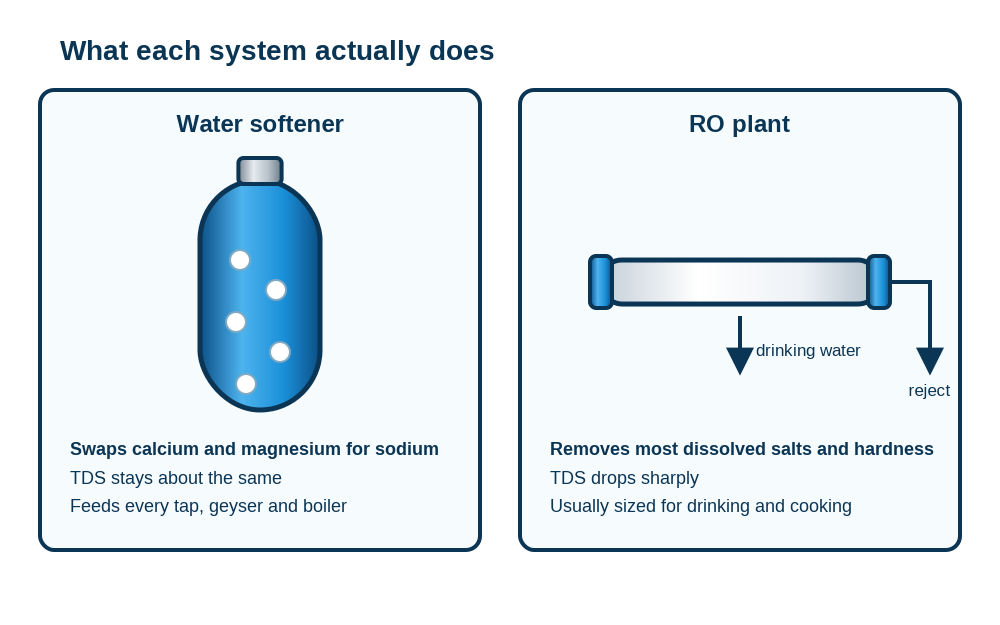
A softener is a vessel of resin beads. As hard water flows through, the beads hold on to calcium and magnesium and release sodium in their place. Every few days the softener rinses the beads with brine from its salt tank to recharge them. Nothing is filtered out, so TDS stays about the same.
An RO pushes water through a membrane under pressure. Water passes. Most dissolved salts, including the calcium and magnesium, do not, and they leave in a stream of reject water. TDS drops sharply.
Water softener vs RO, side by side
| Question | Water softener | RO |
|---|---|---|
| Stops scale? | Yes, on every tap and appliance | Yes, at the RO tap only |
| Lowers TDS and salty taste? | No | Yes |
| Removes bacteria? | No | Not reliably on its own. Add UV. |
| Removes arsenic? | No | Reduces it substantially |
| Treats the whole house? | Yes | Rarely practical |
| Water to drain | Brine and rinse water when it regenerates | Reject water whenever it runs |
| Consumables | Salt | Cartridges, membrane, UV lamp |
| Market price (home) | PKR 75,000 to 95,000 | PKR 28,500 to 40,000 |
Prices are October 2026 market ranges.
When a softener alone is right
- Your TDS is acceptable, below about 500 mg/L, but taps, shower heads and the geyser scale up.
- The problem is in bathrooms, the washing machine and the kitchen sink, not in the drinking glass.
- A hotel, hostel or laundry where scale is costing money on every water heater.
- A boiler whose maker asks for softened feed water.
The signs are listed in our guide to hard water.
When an RO alone is right
- The water tastes salty or heavy and your TDS is above about 500 mg/L.
- Scale is not a big problem in the rest of the house.
- You need drinking and cooking water only, for a family, an office or a shop.
Our home water filter guide helps you choose between RO and simpler filters.
When you need both
Plenty of boring water in Punjab is both hard and high in TDS. In that case the practical setup is a softener on the line from the boring or roof tank, which protects every tap, geyser and appliance, plus a home RO in the kitchen for drinking. The softener also helps the RO, because softened feed water is kinder to the membrane.
The same idea applies at a larger scale. A commercial or industrial RO plant on very hard water usually has a softener ahead of it, or antiscalant dosing when the hardness is moderate. A factory boiler may need a softener, an RO, or both, depending on its pressure. See commercial vs industrial RO.
A note on sodium
A softener adds a small amount of sodium to the water in place of the hardness it removes. The harder the water, the more sodium goes in. If anyone in the house is on a low-salt diet, ask their doctor, and keep the drinking water on an RO tap or a separate unsoftened tap.
What each costs to buy and run
At October 2026 market prices, a small home softener costs about PKR 75,000 to 95,000 and a whole-house softener about PKR 180,000 to 360,000. A home RO costs about PKR 28,500 to 40,000, or PKR 38,000 to 46,000 with UV. Yearly upkeep of a 7 stage home RO runs about PKR 6,000 to 10,000 a year. A softener's running cost is mostly salt, and depends on how hard the water is.
See the water softener page for sizes and options, or every range on the price list.
Sources
- Pakistan EPA, National Standards for Drinking Water Quality (Ministry of Climate Change copy)
- U.S. Geological Survey, Hardness of water
- World Health Organization, Guidelines for drinking-water quality
Prices are market ranges, not quotes, and are rechecked every three months. Standards are quoted as published. For a decision about your own water, go by a test of that water.