Signs of hard water in a Pakistani home
You probably have it if several of these sound familiar:
- White or cream crust on taps, shower heads and the spout of the kettle.
- A geyser that heats more slowly, or a heating element that burns out early. Scale on the element works like insulation.
- Soap and shampoo that will not lather properly, and a grey ring of soap scum in buckets.
- White spots on glasses and steel dishes after they dry.
- Clothes that come out of the washing machine stiff, and a machine that needs descaling.
- Shower heads and tap aerators that slowly lose pressure as the holes block.
What hardness is, in numbers
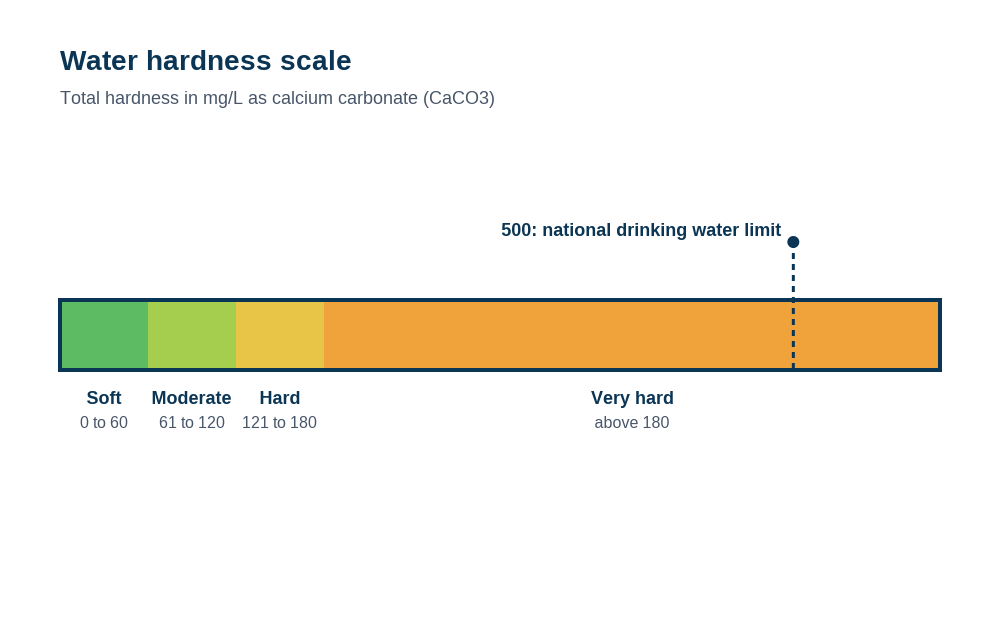
Hardness is the calcium and magnesium dissolved in the water. Rain picks them up as it soaks through limestone and other rock, which is why borewater is usually harder than surface water. Hardness is reported in mg/L as calcium carbonate (CaCO3), and the usual scale runs like this:
| Hardness (mg/L as CaCO3) | Class | What you will notice |
|---|---|---|
| 0 to 60 | Soft | Lathers easily, little or no scale |
| 61 to 120 | Moderately hard | Slow scale on kettles and shower heads |
| 121 to 180 | Hard | Visible scale, spotted glasses, poor lather |
| Above 180 | Very hard | Fast scale on geysers, taps and pipes |
Pakistan's National Standards for Drinking Water Quality put total hardness below 500 mg/L. That is a drinking water limit, not a comfort level. Water well inside it can still ruin a geyser element.
How to confirm it with a test
The scale itself is strong evidence, but a number helps you size a softener. Hardness test strips change colour in a few seconds. A drop kit counts drops until the colour changes, which gives a closer figure. A laboratory gives the exact value, split into calcium and magnesium.
A TDS meter cannot measure hardness on its own, because it reads all dissolved salts together. Our free general test covers TDS and pH, so tell us if you also want hardness checked. The guide to testing water quality at home explains each method.
Is hard water bad to drink?
WHO has not set a health-based guideline for hardness. Calcium and magnesium are minerals people take in from food anyway. The problems are practical: scale, wasted gas and electricity, short appliance life and a heavier taste.
Very hard borewater often has a high TDS as well, and that is a separate question. If your TDS is above about 500 mg/L, see our guide to safe TDS levels.
What actually fixes hardness
Each fix below works on a different part of the problem. The most common mistake is buying a drinking water filter and expecting the geyser to stop scaling.
| Treatment | What it does | Treats the whole house? |
|---|---|---|
| Ion exchange water softener | Swaps calcium and magnesium for sodium. Stops scale. | Yes, on the main supply |
| Home RO | Removes hardness and most salts from drinking water | No, one kitchen tap |
| Shower or tap cartridge | Slows scale at one point for a while | No |
| Magnetic or electronic descaler | Claims to change how scale forms. Independent results are inconsistent. | Claimed, not proven |
| Vinegar or citric acid | Dissolves scale that has already formed | No, cleaning only |
| Antiscalant dosing | Keeps hardness from scaling RO membranes and boilers | Plant equipment only |
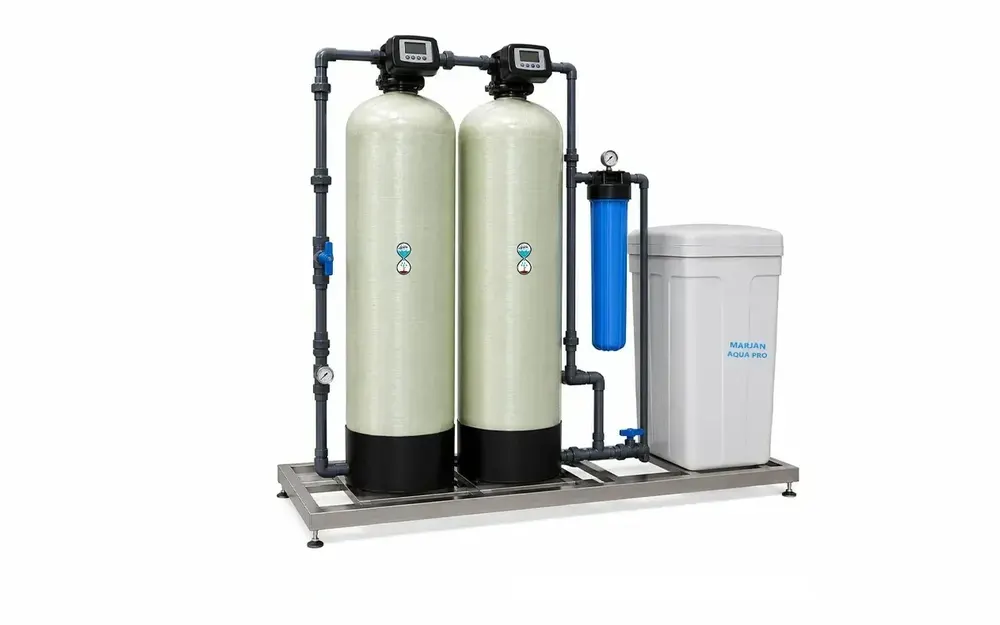
For most homes with scaling problems, the answer is a softener on the line from the roof tank or the boring, plus a home RO for drinking water if the TDS is high. Our comparison of a water softener vs RO goes through when you need one, the other or both.
Two honest limits. A softener does not purify water, so bacteria and arsenic pass straight through it. And it adds a small amount of sodium in place of the hardness, which matters for anyone on a low-salt diet.
Hardness, RO plants and boilers
Hardness causes trouble well beyond the bathroom. In an RO plant, it forms scale on the membranes and cuts their output. Moderate hardness is handled by antiscalant dosing before the membranes. Very hard water needs a softener ahead of the RO.
In a factory boiler, scale on the tubes means more fuel for the same steam and, eventually, overheated tubes. Sialkot's surgical instrument and sports goods units that run steam boilers usually need a softener at minimum, and sometimes RO, depending on the boiler's feed water specification. See industrial RO and boiler feed water.
What a softener costs
At October 2026 market prices, a small home softener costs about PKR 75,000 to 95,000, a whole-house softener about PKR 180,000 to 360,000, and a commercial unit for 800 to 1,000 LPH about PKR 285,000 to 360,000. The size depends on how hard the water is and how much you use each day, so a hardness figure gives you a firmer quote.
Full details are on our water softener page, and every range is on the price list.
Sources
- Pakistan EPA, National Standards for Drinking Water Quality (Ministry of Climate Change copy)
- U.S. Geological Survey, Hardness of water
- World Health Organization, Guidelines for drinking-water quality
Prices are market ranges, not quotes, and are rechecked every three months. Standards are quoted as published. For a decision about your own water, go by a test of that water.