TDS stands for total dissolved solids. It is everything dissolved in the water that is not water itself: calcium, magnesium, sodium, chloride, sulphate, bicarbonate and smaller amounts of many other things. It is measured in milligrams per litre (mg/L). Most pocket meters show ppm, which is the same number, so 300 ppm and 300 mg/L mean the same thing.
The TDS limits that apply in Pakistan
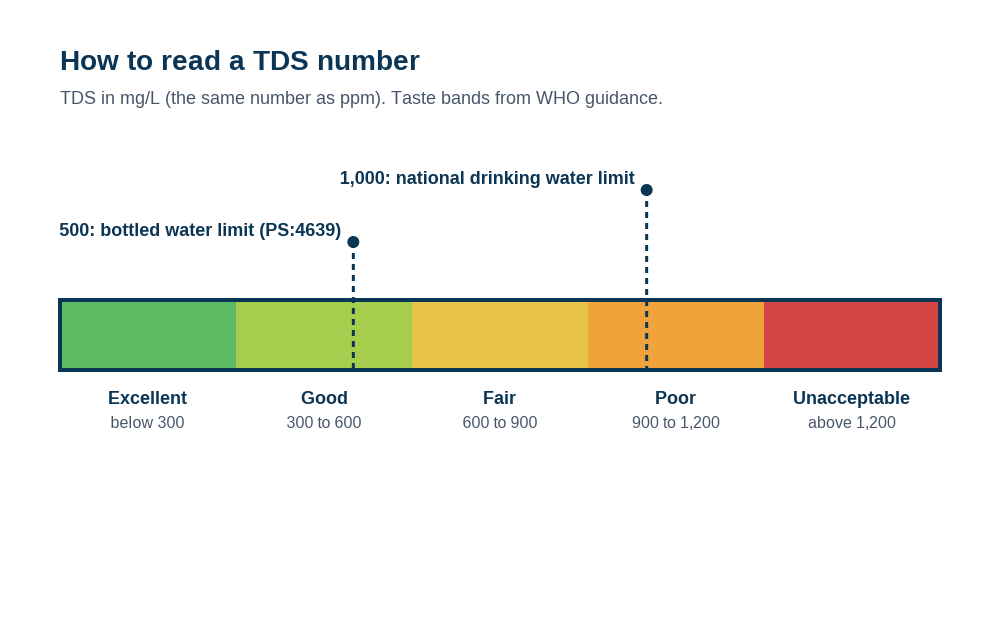
Pakistan's National Standards for Drinking Water Quality, notified by Pakistan EPA, set TDS for drinking water at below 1,000 mg/L. Bottled drinking water has a stricter limit of 500 mg/L under its Pakistan Standard, PS:4639.
Neither number is a health threshold in the way an arsenic or nitrate limit is. WHO has not set a health-based guideline for TDS at all. The limits exist mostly because water above about 1,000 mg/L starts to taste salty or bitter, leaves scale and is rejected by most people.
| Standard | TDS limit | What it covers |
|---|---|---|
| National Standards for Drinking Water Quality | below 1,000 mg/L | Tap, boring and supplied drinking water |
| PS:4639 bottled drinking water | 500 mg/L or below | RO-treated water sold in bottles |
| WHO guidelines | No health-based value | Taste guidance only, rated by panels of tasters |
TDS chart: what your reading means
Read your number against the chart below. The colour bands come from taste panels cited in WHO guidance. The two markers are the Pakistani limits.
| TDS (mg/L) | Taste rating | What we usually recommend |
|---|---|---|
| Below 300 | Excellent | No RO needed. If the source is a tank or old pipes, a 3 stage UV filter handles dirt and germs. |
| 300 to 600 | Good | Usually fine. RO only if the family dislikes the taste or the water scales badly. |
| 600 to 1,000 | Fair to poor | Inside the national limit but often tastes heavy. A home RO is the usual choice. |
| Above 1,000 | Poor to unacceptable | Above the national limit. RO is the practical answer. |
These are taste and treatment guides, not a safety certificate. The sections below explain why.
Is 30, 70 or 95 TDS safe? Common readings answered
Every one of these readings is inside Pakistan's drinking water limit. What changes is the taste and whether a filter is worth it. Find the number on your meter:
| Reading (ppm) | Within the limits? | What it means |
|---|---|---|
| 30 | Yes | Very low. Normal straight after an RO membrane. Tastes flat. A mineral cartridge helps. |
| 70 | Yes | Low. Clean, light taste. Fine to drink if the water is otherwise clean. |
| 95 | Yes | Low. Same as above. No RO needed for taste. |
| 150 to 250 | Yes | Rated excellent for taste in WHO guidance. |
| 300 to 500 | Yes, including the bottled water limit | Good. Most people are happy with the taste. |
| 500 to 1,000 | Inside the national limit only | Heavier taste. Above what bottled water may contain. |
| Above 1,000 | No | Above the national drinking water limit. |
A low number is not a problem in itself. Some sellers say water below 100 or 150 ppm is unhealthy, or that anything above 300 is unsafe. Neither matches Pakistan's standard or WHO guidance. What a low or high number cannot tell you about is germs and arsenic, covered further down.
How TDS varies across Pakistan
TDS depends on the rock and soil the water passes through, so it changes from region to region and often from one boring to the next. Groundwater picks up salts as it moves underground. Where the water table is saline, readings run far above anything a home filter is built for.
In September 2026, the director of PCRWR's National Water Quality Laboratory gave some figures that show the spread. Islamabad's water generally reads 300 to 600 mg/L depending on the source. Hunza's is around 200 mg/L. In Cholistan, in southern Punjab, groundwater reaches 25,000 to 30,000 mg/L.
Bottled water is not automatically better. In PCRWR's April to June 2026 round of tests, covering 230 samples from 20 cities, 29 bottled and mineral water brands were found unsafe. 22 had bacteria, 9 had sodium above the 50 ppm limit and 4 had TDS above the 500 ppm bottled water limit.
We do not publish city averages, because a city average says little about your boring. Two borings on the same street in Sialkot can read very differently. Test the water you actually drink.
Can TDS be too low?
Yes, for taste, and that is about all. Water straight off an RO membrane can read under 20 mg/L. It is not dangerous, and Pakistan's standard sets no lower limit, but WHO guidance notes that water with very low TDS can taste flat and insipid. That is why most home RO units in Pakistan finish with a mineral cartridge, which adds back a little calcium and magnesium.
If your RO water reads very low and the family complains it tastes like nothing, ask for a mineral cartridge or a TDS controller valve. Do not bypass the membrane to raise the number. That brings back whatever the membrane was removing.
What a TDS number does not tell you
A TDS meter measures how well water conducts electricity, then converts that into an estimate of dissolved solids. It cannot tell one dissolved substance from another, and it cannot see anything that does not conduct.
- Bacteria and viruses. Germs from a leaking sewer line or a dirty roof tank do not change the reading at all.
- Arsenic. Harmful at a few micrograms per litre, far too little to move a TDS meter. See our guide to arsenic in Punjab groundwater.
- Nitrate, fluoride and lead. Each has its own limit and needs its own test.
PCRWR's national water quality laboratory has made the same point publicly: an acceptable TDS does not mean the water is fit to drink. A normal reading tells you the taste and the salt load. Safety needs a laboratory.
How to check TDS at home with a meter
A pen type TDS meter costs about PKR 800 to 1,650 in the market (October 2026). Ours is listed here, delivered across Pakistan. It is the cheapest way to see whether your filter is still working.
- Fill a clean glass from the tap you want to check. Let a running tap flow for a few seconds first.
- Take the cap off, switch the meter on and dip it to the line marked on the body. Do not let the display get wet.
- Stir gently once to clear air bubbles, then wait until the number stops changing.
- Rinse the tip with clean water and dry it before putting the cap back.
To check a home RO, test the raw water and the filtered water on the same day. A working membrane removes most of the dissolved solids, typically well over 90 percent. If the filtered reading creeps up month after month, a cartridge or the membrane needs attention. Our RO service team can check which.
TDS after RO: what your filtered reading should be
Take the reading before the mineral cartridge if you can, or at the tap if you cannot. The mineral cartridge adds a little back, so the tap reading is always somewhat higher than the membrane outlet.
| Raw water TDS | Membrane outlet at 90% removal | Check the membrane if it reads above |
|---|---|---|
| 300 | about 30 | about 60 |
| 600 | about 60 | about 120 |
| 1,000 | about 100 | about 200 |
| 1,500 | about 150 | about 300 |
The right-hand column is a rough trigger, not a rule. A new membrane often does better than 90 percent, and a reading that drifts up steadily over a few months matters more than any single number.
What lowers TDS, and what does not
| Method | Lowers TDS? | What it is actually for |
|---|---|---|
| RO (reverse osmosis) | Yes, sharply | Salty or heavy water, hardness, many heavy metals |
| Deionisation (DI resin) | Yes | Rinse water, laboratories, battery water |
| Distillation | Yes | Small volumes only |
| 3 stage UV filter | No | Dirt, chlorine taste and germs |
| UF (ultra filtration) | No | Silt, rust and germs for the whole house |
| Water softener | No | Scale on geysers, taps and boilers |
| Boiling | No, it rises slightly | Killing germs |
If your reading is above about 500 mg/L and the water tastes heavy, the answer is a home RO for drinking and cooking. For a shop, school or factory, it is an RO plant sized in litres per hour. Below that, the question is usually dirt and germs rather than salt, and a cheaper filter does the job. Our guide to choosing a water filter for home walks through each case.
Not sure of your number? We test TDS and pH free at our shop in Bajwa Market, Ugoki, or you can send a sample by TCS from any city. See how the free water test works.
Sources
- Pakistan EPA, National Standards for Drinking Water Quality (Ministry of Climate Change copy)
- Health Canada, Total dissolved solids guideline technical document (includes the WHO taste ratings)
- World Health Organization, Guidelines for drinking-water quality
- The Nation, PCRWR on TDS and water quality across Pakistan (September 2026)
- PCRWR, Quarterly report on bottled water quality, April to June 2026
- The Nation, 29 bottled water brands found unsafe for consumption (August 2026)
Prices are market ranges, not quotes, and are rechecked every three months. Standards are quoted as published. For a decision about your own water, go by a test of that water.