Start with osmosis
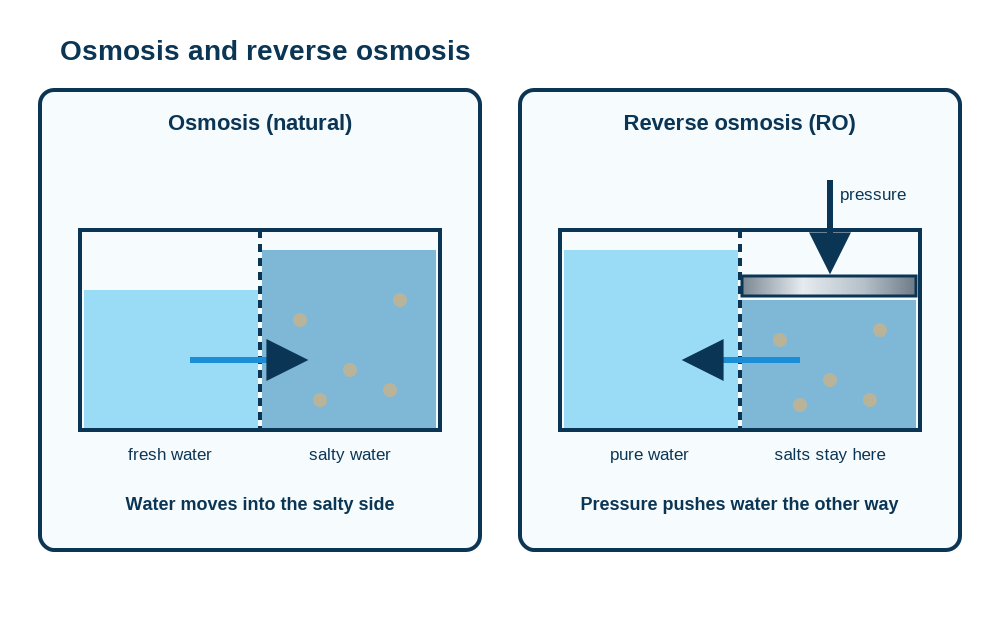
Put fresh water and salty water on either side of a membrane that lets water through but not salt. Water moves on its own into the salty side, trying to even out the difference. That is osmosis, and it is how roots draw water from soil.
Reverse osmosis pushes the other way. Apply enough pressure to the salty side and water is forced back through the membrane into the fresh side, while the salt stays behind.
How an RO membrane works
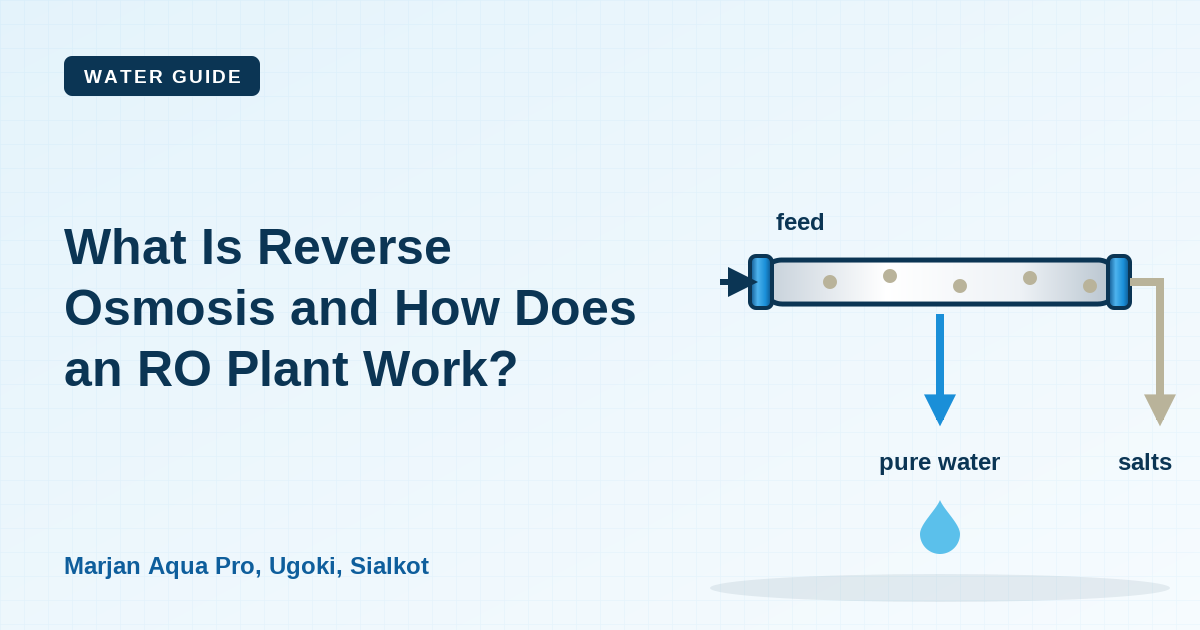
An RO membrane is a thin sheet, rolled into a cylinder with spacers so water can flow along it. Feed water runs along the surface under pressure. Clean water, called permeate, passes through the sheet and is collected in a central tube. The rest carries the rejected salts out of the other end as reject water, also called concentrate.
The saltier the feed water, the more pressure it takes to push water through. That is why a home RO has a small booster pump, and a commercial plant on high TDS borewater has a high pressure pump. Home membranes are rated in gallons per day. Commercial plants use 4 inch or 8 inch elements, and bigger plants simply use more of them.
What RO removes, and what it does not
| Contaminant | Does RO remove it? | Notes |
|---|---|---|
| Dissolved salts (TDS) | Yes, most of them | This is the main reason to use RO |
| Hardness (calcium, magnesium) | Yes, most of it | Very hard water needs antiscalant or a softener to protect the membrane |
| Arsenic | Reduces it substantially | Confirm with a lab test of the treated water |
| Fluoride, nitrate, lead | Reduces them | How much depends on the membrane and the water |
| Bacteria and viruses | Holds back most, not guaranteed | Add UV after the membrane |
| Chlorine | Damages the membrane | Removed by a carbon filter before the RO |
| Dissolved gases such as carbon dioxide | No | Why RO water often reads slightly below pH 7 |
That last row explains a common worry. RO water often tests a little acidic, because carbon dioxide passes through while the minerals that balance it do not. Our pH of water guide explains why it is normal.
Where the reject water goes
Every RO sends part of its feed to the drain. That stream carries away the salts the membrane held back, and without it the membrane would clog within hours. On many home units the drain water is more than the filtered water. Commercial plants are designed to recover a larger share, but the exact figure depends on the feed TDS and the design.
Reject water is fine for mopping floors, washing cars and flushing. It is saltier than the water that went in, so it is a poor choice for watering plants if the feed was already salty.
The stages around the membrane
The membrane does the main work, but it cannot work alone. A home RO usually runs a sediment cartridge, then carbon, then the membrane, then often a UV lamp and a mineral cartridge. A commercial plant adds a raw water tank, sand and carbon filters, antiscalant dosing and micron cartridges before the high pressure pump. Each stage protects the next one.
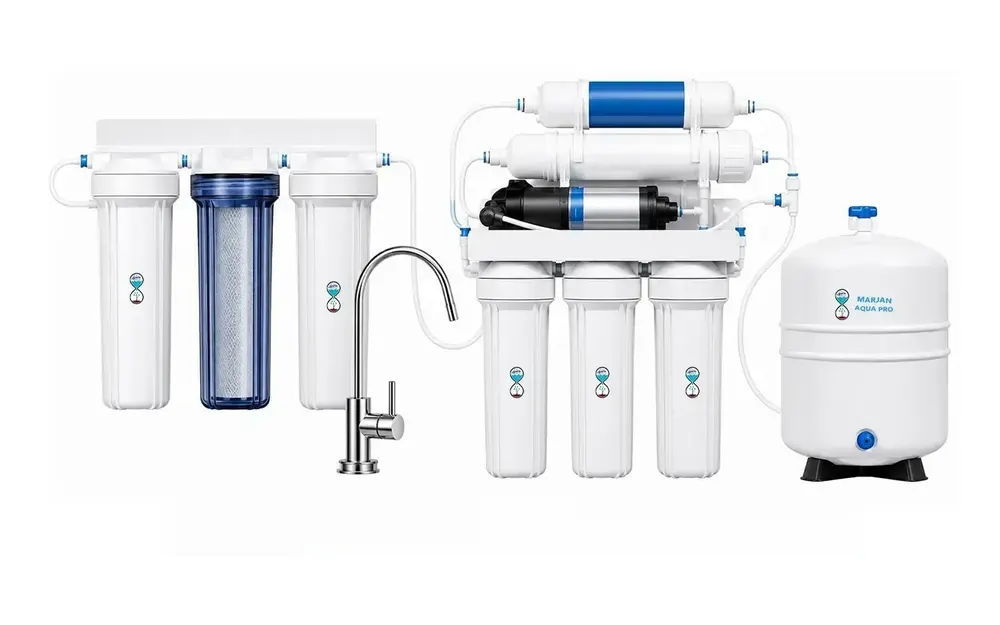
Skipping pre-treatment is the most common reason membranes fail early. The full commercial stage list is in our guide on how to choose an RO plant.
When you need RO, and when you do not
RO earns its cost when the water is salty or heavy. Above about 500 mg/L TDS the water usually tastes heavy, and above 1,000 mg/L it is over Pakistan's drinking water limit. It is also the practical drinking water answer for arsenic, once a lab test confirms it.
Below about 500 mg/L, an RO mostly removes minerals you do not need to remove and sends water down the drain to do it. A UV filter or a UF plant is usually the better choice. Our TDS guide has the full chart.
At October 2026 market prices, a home RO costs about PKR 28,500 to 40,000, and a 500 LPH commercial plant about PKR 490,000 to 650,000. See the home filter models and prices.
Sources
- World Health Organization, Guidelines for drinking-water quality
- Pakistan EPA, National Standards for Drinking Water Quality (Ministry of Climate Change copy)
Prices are market ranges, not quotes, and are rechecked every three months. Standards are quoted as published. For a decision about your own water, go by a test of that water.